Agents
Overnight Built Idea: Second-Brain for Hermes
Last night, I read a post on Reddit about how to connect Obsidian to Hermes, and I noticed that the author still had a few issues to solve. I came up with an idea overnight and tested it as well.
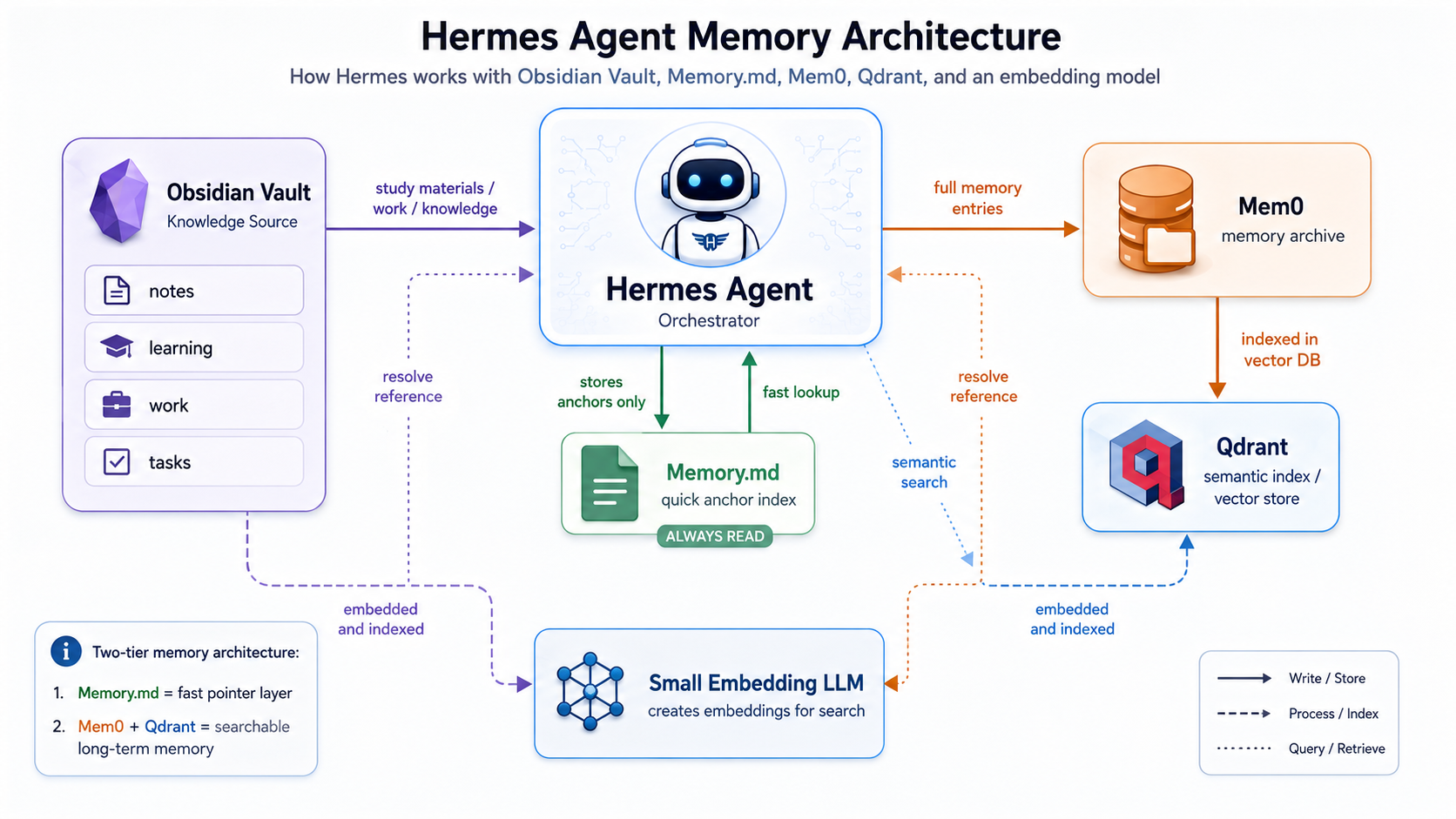
Hermes has a Memory.md file, while I use Mem0, Qdrant, and a small embedding model.
I taught Hermes to use Memory.md as an “anchor” file. It places short anchors there that point to the memory files stored in Mem0. This way, Memory.md acts as a fast index, while Mem0 serves as the actual memory archive.
I connected my Obsidian vault in the same way. Hermes receives study materials, work, and other information there, and whenever there is something it must remember, it adds a few lines to Memory.md and records where the full information is stored.
Hermes always reads Memory.md, so it is the best place for this kind of indexing.
The critical point is that an anchor should not be merely descriptive text, but a stable, resolvable reference. For example:
[MEM0:mem_01JXYZ…] Hermes memory architecture: Memory.md stores anchors only.
[OBSIDIAN:Learning/Python/DSA-index.md] Current DSA learning plan and progress.
[BRAINPAL:Hermes_Learning_Notes/index.md] Hermes-maintained learning notes index.
This prevents Memory.md from growing uncontrollably and allows Hermes to clearly determine:
What to search for, which storage system to search, which identifier or path to use to resolve the reference, and when the anchor should be updated or removed.
This is essentially a two-tier memory architecture: a fast, always-available pointer layer, with a large searchable store behind it. Hermes’s own repository inside Brainpal can serve as a useful operational layer, as long as it does not start duplicating the same information in full across all three locations.
And this can be developed even further.